
LightningJS or React Native for TV App Development?
By Chris Lorenzo · Published May 27, 2025 · 3 min read
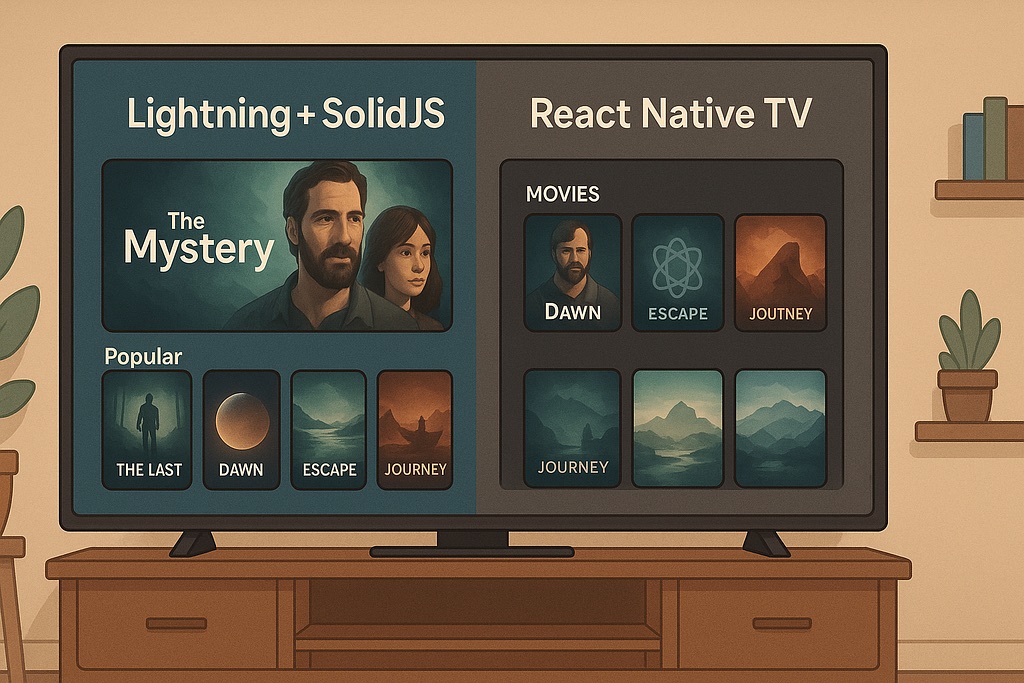
As the demand for rich, responsive TV apps grows, developers are sizing up their options for building high-performance experiences tailored to the quirks of TV platforms. Two frameworks often considered: LightningJS and React Native. Both are solid, but they take very different routes in terms of architecture, performance, and overall developer experience.
TL;DR
- React Native is great for teams already using React who want to move quickly and share code. But expect extra work for focus management, performance tuning, and debugging.
- LightningJS is purpose-built for TV, and when paired with SolidJS, gives you unmatched performance, control, and a surprisingly smooth dev experience.
If you already have a development team, lean towards what they are most comfortable with. Web developers? Go with SolidJS and Lightning. Native devs or backend engineers — check out React Native.
LightningJS
LightningJS is an open-source WebGL renderer built specifically for TV platforms and runs in a Web Browser. Originally developed by Metrological, it now powers apps on LG webOS, Samsung Tizen, and even Fire TV and Android TV (via web view). It's all about performance and you can bring your own framework to build on top — I recommend SolidJS.
React Native for TV: The Hype and the Reality
React Native, built for mobile, has extended to TV with React Native for Android TV and tvOS. The pitch is compelling: reuse components, business logic, and developer know-how across platforms. Write once, run (almost) everywhere. If your team is already in the React world, it makes sense. But in practice, things get a bit more complicated:
- Focus is fiddly. Handling remote input and tvOS-specific UX often means custom workarounds or separate component logic.
- Performance has limits. Fine for simple UIs, but once you throw in animations or anything complex, it can start to chug compared to pure native or WebGL-based renderers.
- Debugging can be a pain. You're often tracing bugs across JavaScript, native bridges, and platform-specific code. Sometimes you're knee-deep in Swift, Objective-C, or Kotlin.
That said, React Native for TV is improving quickly. The new architecture (0.76) is snappier, and if your app is fairly lightweight or your team is deep into React, it's worth a look. Just be ready for the extra layers when debugging (though 0.79 has some new tools to make that easier). And fair warning: React Native Web builds for LG and Tizen don't perform nearly as well as Lightning's WebGL rendering. Sometimes, it's faster to build a few tailored codebases than to wrestle a unified one into shape.
LightningJS with SolidJS
One of LightningJS's best features? It doesn't force a framework on you. It's just a renderer. You get to pick how you build.
That's where SolidJS comes in.
Solid is known for being ridiculously fast, with fine-grained reactivity and no virtual DOM overhead. Combine that with Lightning's GPU-accelerated rendering and you've got very fast TV apps.
- Fast ramp-up. If you know Solid (or React), you can learn Lightning in a few days.
- No CSS headaches. Lightning skips the usual CSS weirdness across TV platforms. Styling is straightforward and consistent.
- Production ready. You can build scalable, responsive TV apps with a proven, modern frontend stack.
- Large community. Much easier to hire web developers than native devs, and SolidJS has 10k+ folks on its Discord.
It's a great combo: best-in-class reactivity and composability from SolidJS, with high-performance rendering from LightningJS. LightningJS is a web based framework and will deploy "natively" to LG and Tizen TVs — for Android / Fire TV devices you can wrap the web app with a WebView and deploy to the TVs using React Native (so you get to use both). However, you'll still need to build a solution for tvOS as they don't allow WebViews.
Need Help?
If you're diving into TV app development and want expert guidance with LightningJS, get in touch! See SolidTV support & services to learn more, or reach out directly. Whether you're building from scratch or migrating an existing app, we're happy to help.
Resources
- github.com/solid-tv/solid
- github.com/react-native-tvos/react-native-tvos
- reactnative.dev/blog
- github.com/solid-tv/solid-demo-app
- Join the SolidJS Discord: discord.com/invite/solidjs
Related: why React web apps are slow on older TVs, and why Preact doesn't fix it.
Originally published on Medium.